Showing posts with label thriller. Show all posts

Sunday, May 19, 2013

Thy Fearful Symmetry


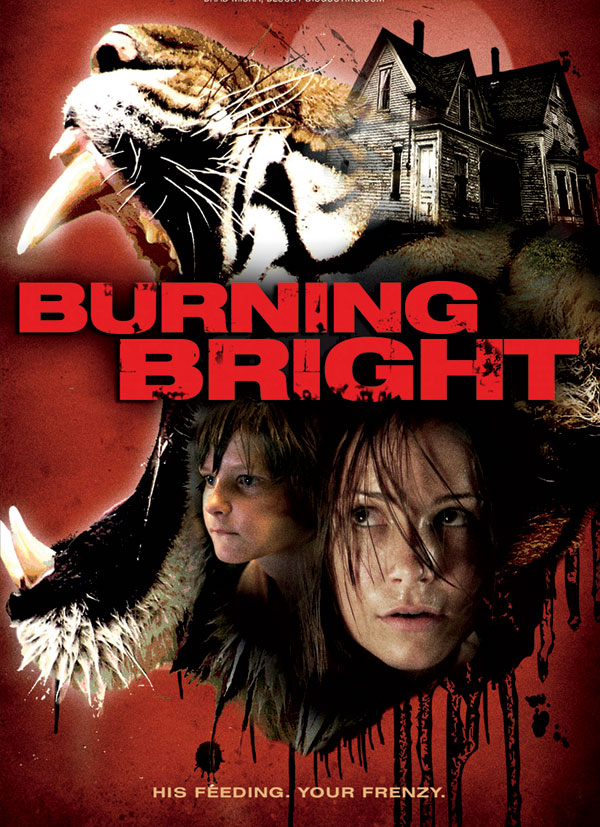
Burning Bright (2010)
Director: Carlos Brooks
Rated: PG13

I dug up this film while going through Garret Dillahunt's IMDb page—trying to find at least one movie he'd been in where he wasn't a bad guy. The man is typecast, I swear. I found this recent (sort of) title and, having never heard of it (despite its original premise), decided to check it out.

It's about a young woman and her autistic brother trapped in a boarded-up house with a Bengal tiger during a hurricane.

Trust me, it's actually pretty good.

The film opens with a cameo by Meat Loaf. He's not in the credits, but it's kind of hard to miss the guy when you're from my generation. Dillahunt's character, Johnny, is trying to buy a Bengal tiger for his safari venture and Meat Loaf is warning the man about the danger of the specific tiger he's got in the cage. It's attacked people before.


There are two things going on here. Johnny has spent, like, all of the family's money (he's the stepfather—the mother committed suicide) on this safari thing and has basically wasted it all. Our protagonist, Kelly (Briana Evigan), needs to send her brother to a hospital for his special needs, however, and they can't afford it. She has a scholarship for college, but must start within the next semester because she has cited family issues to defer twice beforehand. Which means she is putting off college to take care of her little brother. She confronts her stepfather and they argue.


The second plot point is the coming hurricane. The house is boarded up tight and Kelly falls asleep. She wakes during the storm, finds a note from Johnny saying that he went to the store, and then sees a huge Bengal tiger cross the hallway. Did I mention that he's been starved for a while now?


She can't leave the house because it's all boarded up from outside. She can't get through to emergency services on her cell phone because the call volume is so high during the hurricane. Spoiler, Johnny is the one who let the tiger loose in the house. He has hunkered down in a bar for the duration of the storm—possibly with the intention of collecting the insurance money in the event of the kids' deaths.

Pictured: an utter douchebag

And he would have gotten away with it had Kelly been less resourseful. There is a brilliantly filmed moment where she's hiding from the tiger in the laundry chute—her bare feet sliding and gripping the metal as the animal prowls below, peeking up the laundry chute when he hears her.


It's not a masterpiece of a movie. It drags here and there and the plot is a little questionable (did Meat Loaf just advertise "man-eating tiger" on CraigsList or something?). But it is a bit of a unique twist on the old "killer in the house" trope. Because of the hurricane, Kelly can't simply grab her brother and run outside. She can't get through to the authorities because emergency services is too clogged up. Dialogue kind of suffers, though, in place of these riveting moments with the tiger. The tiger, himself, is cleverly filmed. This is not a computer generated animal. This tiger is real and very menacing. Remember the scene with the tiger in Gladiator and how that was so cool? Okay, maybe not, but my point is that the filming technique in Burning Bright is something worth seeing.


Now, is this movie worth buying? Well, the DVD comes with special features, so it is. In my mind, a DVD has infinite re-watchability if it includes something like a behind the scenes documentary or a commentary track. So, check it out. The set-pieces with the tiger alone are very much worth seeing. And it's a clever take on the "killer in my house" trope since Kelly can't leave due to the hurricane. Even if she managed to get outside the house, where the hell is she going to go to get out of the storm?


Nowhere, that's where. 

Saturday, September 4, 2010

Who Would Want To Live Forever?


Immortality (or The Wisdom of Crocodiles) 1998
Dir: Po-Chih Leong
Rated: R

Okay, I give. I'm a big fan of vampire movies and I've been trying to find one as unique as Near Dark for a while now. And, while I love 30 Days of Night and its constant level of "this really sucks for these people," I do enjoy the more subtle vampire story even more.

This happens to be damn near impossible to find, by the way.

Jude Law as a vampire? This was too interesting to pass up.

That's better, Jude.

I only stumbled across The Wisdom of Crocodiles (Immortality to those of us in the US) because I've been on a Jude Law "binge." I think I sat here and watched eXistenZ about five times in a row (I'll review that one later). My brain wandered off into La La Land while he chowed down on some truly disgusting looking fish in one scene and I ended up ticking off movies I hadn't seen with Jude.

This one popped up.

It took me ages to find a copy of it—and even then it's only a digital file. But it is available through Amazon.com and (I'm assuming) Netflix.

Jude plays this guy named "Steven Grlscz." That's pronounced "Grill-sh."

No, really. He has no vowels in his last name.

In the opening of the movie, we're introduced to him and his goofy hair as he watches his girlfriend's car get pulled out of a tree. In the background, you can hear one of the mechanics wondering out loud to someone "where all the blood is."

Steven seems to take this news rather well and goes off in search of a new girl. He finds Maria on the Underground platform and stops her from jumping in front of a speeding train. Long story short, Steven gets her to fall in love with him, then kills her all vampire-like, and disposes of the body on the coast when the tide is out.

OH MY GOD, JUDE, I WOULD NOT HAVE GONE THAT DIRECTION WITH THE HAIR.

There is an interesting moment where he demonstrates just how fast he is by sitting way across the room from her at one point, telling her to close her eyes, and BAM! He's right in front of her. It's your basic "I'm showing off" scene that is strangely charming.

He's finally rid of the awful hairdo the next time we see him. He's sketching a lovely woman named Anne (played by Elina Löwensohn) who is an engineer at a building site where she's giving some kids a tour of the place. He strategically sets up a guarantee that he'll meet her later and they end up starting a relationship.

I say "relationship" because Steven doesn't try to trick Anne—he's actually himself quite a bit around Anne. Not like the act he put on for Maria.

The thing is, the police found Maria's body. And they have a link between her and Steven. It's enough of a link that the Inspector (Timothy Spall in a rare "non-creepy-dude" role) and Sergeant (Jack Davenport) question Steven about their relationship. They also follow him for at least a week or so.

Hi, Admiral Norrington!

LOOK! PETER PETTIGREW/BEADLE BAMFORD IS NORMAL FOR ONCE!

Steven keeps an entire hidden library full of scrapbooks with information on the women he's seduced and drained like Slurpees. He also keeps a wooden box with these crystals in it—each one is labeled for the woman it was essentially created from. As Steven mentions later on, he's writing a study on how the human body can actually create crystals when put under high amounts of stress. He postulates that each crystal can have its own emotion attached to it.

How does he get the "memento" crystals after feeding off his victims?

Think "kidney stones."

Yeah, they all look like this, too.
That one hurt me.

Again, like Near Dark, the "v" word is never said aloud. In fact, I'm not even sure if this counts as a vampire movie. Yes, he drinks blood (but says he feeds on the emotion in the blood). Yes, he is ageless. Yes, he's incredibly fast and gifted. But he also has a reflection, no aversion to crucifixes, and can walk around in daylight. That last one is handy considering Steven has a job at the hospital as a medical researcher ("I solve problems"). We do have a scene where he's comforting a young girl while he uses radiation on a cancerous mass in her abdomen. It's very sweet, actually. It shows how he can care for human life—he distracts her and makes her focus on his eyes as he works the machine.

See? Things don't seem so scary when your medical technician looks like this.

Despite his growing attachment to Anne (to me he was clearly in denial of his own feelings) he continues with the somewhat magpie-like act of picking up things she's doodled, writing notes on her character, and drawing portrait after portrait of her. He even tries to copy a swirling doodle she did on some engineering notes but can't quite get it right. So he staples the original in the creepy scrapbook.

He staples his finger.

The next day, on another date, Anne points to the band-aid and asks him what happened.

"This? I cut this saving a puppy from drowning." SMOOCH.
Then there's a scene involving a gang of hoodlums that Steven and the Inspector encountered earlier, but that's more fun to watch without knowing what the hell is going to happen.

Anyway, before I give even more of the plot away to all of this, I have to mention at least two more things. One is the Song Of Solomon. He and Anne recite it to each other and I cannot think of any other instance in film where the poem is used. It's romantic the way they speak it. Not a "lusty" type of romantic but a closer kind of attachment that really feels like it could be love. So it's all the more tragic when you see him later on after they've had a fight and he's folding a rubber sheet to get ready for eventual clean up and body disposal.

Then there's this... Bleeding from the ears is never a good sign. Especially when a new paper cut could make you bleed out.

No, no, no... That's not any better, Steven. That's actually the opposite of "better."

The other thing I need to mention is his depleting strength. He's gone so long without blood that his finger doesn't heal. He has to remember to breathe and keep his heart going. His body is literally eating itself and at one point he loses his eyesight.

See? NO GLITTERING. Much better.

Okay, since the movie is so hard to find, I will give away a little bit of the ending. He can't kill her. Not because he's too weak, but because he just likes her too much. He's spent more time with her than the other women. She's become a part of his life (if you can call it "life") and he forces himself to stay away from her even as he gets hungrier and his cut finger stops clotting altogether. The plot of Steven and his struggle with his survival instincts and his genuine care for this woman is not the only one. The cops are still looking for Maria's killer.

He even gets pulled into a line-up for the toll operator (WHO SAW HIM DRIVING THE "BODY-DUMPING" VAN) to identify at one point.

The secondary plot of the Inspector and Sergeant investigating Steven is actually just as interesting as the primary plot between Steven and Anne. Sometimes this kind of thing can leave one plot thread less wound than the other, but in Immortality both spools are full. It is equally as suspenseful to see Steven grow closer to Anne as it is to watch him speak one-on-one with the Inspector.

The original title comes from a conversation Steven and Anne have about how the brain works—which worms its way from the following block quote into a story Anne has about a watch she stole when she was little. She could afford it, but she just took it—and kept it to remind her of her shame.
"I once knew this doctor—a neurologist. He told me that we don't have one brain. We have three... One that is human built over another that is mammalian built over yet another that is reptilian. So when a psychiatrist asks you to lie down on a couch, you're being asked to lie down with a horse. And with a crocodile."
Steven also does this:

I dare you to try this and not fail.

Draw a portrait with one hand and write the Song Of Solomon with the other! IMPRESS THE LADIES!

I've watched it about three times in a row by now and have come to the conclusion that this story isn't just about how Steven is this odd immortal creature who kills women after he seduces them to keep looking young. It's more about his struggle to accept "letting go." And not from the female perspective at all. This is about Steven letting go. He mentions a childhood memory about falling out of a tree and snagging onto a branch and holding on until his arms were nothing but pain. He doesn't remember landing on the ground at all—he just remembers "the agony of holding on and the wonderful feeling of letting go." It's what he spends the entire time trying recreate and he can only do this by really letting go of the existence he's made for himself. Lonely, painful, and pretty darn illegal.

Proper vampires don't have only ONE facial expression. Some can cry.

And a normal woman gets freaked out when her boyfriend confesses that he wanted to kill her/tries to actually eat her.

This is another one for the "Jenn Recommends It" pile. I need to start reviewing bad movies, don't I?

Tuesday, August 17, 2010

AMBER Alert


Hard Candy (2005)
Dir: David Slade
Rated: R

So sometimes we get these sleeper films that become cult and thus the focus of independent accolades. We also get real stories that don't fall into the category of "summer blockbuster" or "fall/winter/we're-hedging-for-an-Academy-Award drama." Hard Candy is one of those films that makes you think. Makes you wonder if there's a girl like Hayley Stark out there avenging those who can no longer speak for themselves. The abused, the murdered, the abducted...

To start, we have Hayley herself:

Ellen Page as Hayley. Playing a bright honor student who is only 14.

Hayley Stark has been Internet chatting with this guy named Jeff Kholver (Patrick Wilson). He's 32. He photographs models. At the beginning of the movie, you immediately feel uncomfortable for Hayley—automatically thinking that she's going to be taken advantage of in the worst way by this guy, and wanting her to be rescued by anyone. They chat online and then meet in person at a coffee shop where he buys her a T-shirt, has her model it for him, and then offers to email her a bootleg copy of a Goldfrapp concert. She "convinces" him to let her listen to it at his house with three reasons: One, she's been seen in public with him. Two, It's Goldfrapp. Three, four out of five doctors agree that she is insane. She gets in his car and they take a long and winding road up to his home.

He brings her a drink, but Hayley suggests she make her drink herself. She pours two screwdrivers and Jeff has no qualms in letting this 14 year-old drink vodka. He's none the wiser. By the time she suggests he take her portrait, Jeff has already given off enough skeevy vibes that when he passes out mid-photo session we feel grateful. As he falls to the floor the expression on Hayley's face reveals that she isn't as naĂŻve as we think... Jeff wakes up tied to a computer chair and Hayley has dropped the "innocent" act.

"You remember what I said about never drinking anything you didn't mix yourself? That's good advice for everyone."

He screams for help, but she sprays chloraseptic in his mouth and tells him "next time, it'll be the bleach" and that she knows no one is around to help him. She explains that she has had multiple chat accounts to find him—that as soon as he found out she was older than 14, he'd stop chatting. He feebly denies it and claims the others "weren't interesting," but Hayley knows better. She knows he copied phrases from Amazon.com about certain obscure bands that she pretended to like ("I fucking hate Goldfrapp."). She knows something we, the audience, don't know. Something that passed us as a blip in the coffee shop in the poster for the missing Donna Mauer. When confronted with his behavior by Hayley—tied to a chair and unable to escape her relentless questioning—Jeff resorts to the blame game.

Jeff: You were coming on to me!
Hayley: Oh, come on. That's what they always say, Jeff.
Jeff: Who?
Hayley: Who? The pedophiles! 'Oh, she was so sexy. She was asking for it.' 'She was only technically a girl, she acted like a woman.' It's just so easy to blame a kid, isn't it! Just because a girl knows how to imitate a woman, does NOT mean she's ready to do what a woman does.
I mean, you're the grown up here. If a kid is experimenting and says something flirtatious, you ignore it, you don't encourage it! If a kid says 'Hey, let's make screwdrivers!' You take the alcohol away, and you don't race them to the next drink!

It's something you want blared from a loudspeaker for everyone to understand.

Hayley is methodical. While he was out, she searched Jeff's apartment for any porn—anything at all. But there's nothing. Not even a copy of Playboy. Which, to her (and me), is really "off." According to Hayley, single men don't hang up photos they've taken of barely clothed young girls throughout their home. She needs proof of Jeff's depravity and searches his computer after reading some private letters sent from Janelle, Jeff's previous obsession. His downloads indicate a pattern, but none of the files are on the computer—leading Hayley to believe he has it hidden somewhere. After an unsuccessful attempt to get her to stop, Jeff begins to finally realize he is not dealing with any normal girl (as Hayley says: "There's that word again; 'girl.'"). She grills him and, without a word, discovers he does, indeed, have things hidden away.

"Nothing's yours when you invite a teenager into your home."

As Hayley searches his place again and finds a gun under his bed. She tosses it on the mattress and continues her search. Jeff vainly tries to escape the tight knots she's used to tie him to the chair. But he stops when he hears rattling. There is a safe tucked into the coffee table and covered carefully in a bed of river rocks. She scoots him back out into the living room and asks him for the password. Underestimating her intelligence yet again, Jeff refuses to tell her. But she can read his face. After trying only five combinations, she finds out it's the date that Jeff first photographed (or had sex with) Janelle (the girl in the framed photo he keeps in his bedroom) and only has to guess on the year.

"This is what they make those Federal laws for, Jeff. This is officially sick."

She finds, amongst the photos and CDs labeled "Stuff" a photograph of Donna Mauer outside the same coffee house she met Jeff at. After asking him what was so special about that girl—why she got to "keep her clothes on," Hayley whispers that she recognizes the girl. Jeff promptly kicks her in the ribs and knocks her against a table, having freed his feet, and tries to get to the gun on the bed. Hayley recovers from the blow. By the time Jeff has the gun in hand and has wheeled back to the living room, Hayley seems to have vanished.

She ambushes him from behind, gets slammed repeatedly into the wall, narrowly escapes being shot, and successfully knocks Jeff out with the help of an entire roll of Saran Wrap. Hayley doesn't kill him. Time passes and Jeff wakes up practically hog-tied to that table he kicked Hayley into. And she's since removed his pants and dropped a Ziploc bag full of ice on his crotch. He threatens, feebly, that he'll call the cops and say he's never touched her. Hayley brings out the damning photograph of Donna. He admits to meeting Donna for coffee and claims he took the photo to make her "happy."

Jeff is still trying to maintain that "I did nothing wrong" front.

We then see that, instead of the layers of tank tops, Hayley has the top half of some medical scrubs on. She threatens to send an email to Janelle (whom Jeff is obviously still very attached to) and there is a lot of "Jeff tries to talk Hayley out of this" stuff—then begging once he realizes she's perfectly willing and capable of making good on her threat of castrating him.

"Turns out castration is one of the easiest surgical procedures around. There's thousands of farmboys across the country gelding their livestock. If they can do it, I think I can pull it off. If you know what I mean."

I won't spoil the rest of the movie (seeing as I've spoiled so much of it already), but it goes without saying that it is a tough subject to sit through. There is the implication of image, but we see nothing. By the end of it all I realized there was no "score" to be exact. The emphasis is all on the dialogue and these two characters. We find out just how messed up Jeff really is through Hayley's consistent pushing. It takes a while—long enough that we've been introduced to Jeff's truer nature.

Jeff: Who the hell are you?
Hayley: I am every little girl you ever watched, touched, hurt, screwed, killed.

It's another pertinent quote. Hayley is an enigma. But she really is every little girl out there who is seen as a potential victim or target. She embodies those kids we want to save from the pedophiles and despicable people out there. She also embodies that person we wish that we could have around to look out for those traumatized and abused children. But to my knowledge, there is no Hayley Stark.

"Honors student, remember? Nothing I can't do when I put my mind to it."

In the end she escapes easily and walks down the road—red hoodie flipped up and looking like an avenging angel for all the abused and damaged girls. We don't know who she is and if she's even finished with her mission to find the abductors of Donna Mauer. We don't even know if Donna is the only one Hayley has "investigated." She claims to not have never done some of the things she does to Jeff. She searches his home thoroughly and precisely. She handles herself with a professional air and, for a fourteen year old, is angry in a way that normal teenagers aren't. Hayley claims her "four out of five doctors agree that I am actually insane" quote is true. To be honest, she does seem like a functioning sociopath.

I wish there was a real Hayley Stark around to work as a vigilante for the "watched, touched, hurt, screwed, and killed." So, despite the delicate subject matter I honestly recommend Hard Candy as a serious film to watch. It's dramatic and heart-pounding—carefully constructed to engage us and suck us into the story to leave us with that "what brilliance did I just watch?" feeling.

And like that, poof. She's gone.

Monday, March 15, 2010

The Mind of a Killer...

The Silence of the Lambs (1991)
Dir: Jonathan Demme
Author: Thomas Harris
Rated: R

At some point or another, we've all seen that clip of Anthony Hopkins in prison blues leaning up against a Plexiglas wall and informing a rather frightened-looking Jodie Foster what he did with a census taker's liver. But how many of us have sat through the entire movie? Read the book?

Quick fact: Tony's creepy little noise at the end of the liver, fava beans and chianti line was an ad-lib that he was sure Jonathan Demme would cut from the final film.


We're given an unconventional hero for us to follow on this dark and twisted journey (in the early 90s, that is). Heroine, to be more precise. Clarice Starling is still in the FBI Academy when the head of the Behavioral Sciences division pulls her out of class to go and chat with "Hannibal the Cannibal." She's the FBI's most promising student—high marks, better than anyone else on the gun range, smart as hell, and tough. Tough in a world where women aren't supposed to be tough and still very much a woman when men look at her (not a "fellow agent"). It's part of the reason why Jack Crawford sends her up to Baltimore to go and get Dr. Hannibal Lecter to fill out a profile in order to help get a better sense of the identity of another psychopathic killer.

That'd be Buffalo Bill.

For a moment, let's step away from the movie and turn to the book. Buffalo Bill, or Jame Gumb, is genuinely disturbed in the head. The character is sort of an amalgamation of Ed Gein, Ted Bundy and Gary Heidnik. I say "sort of" because Buffalo Bill does skin his victims, uses a fake wrist cast to knock them out, starves them, and leaves them in a pit... He is not using them sexually. He doesn't even see women any longer, he just sees "it." He's a shell of a man who lost his mother—he never knew his father and she wasn't the best parent... At one point it's revealed that she hated her son. She never even bothered to add the missing "s" to the end of his name on his birth certificate. The point is, Jame Gumb doesn't know
who he is and after studying the Death's Head moths he raised, he decided to change himself. To put it more succinctly, Buffalo Bill is one messed up dude.

So Clarice is basically sent to Baltimore as eye candy bait ("Lecter hasn't even seen a woman in years...") has to put up with the crude Dr. Chilton who runs the asylum Lecter is held in, and meets possibly the most patient and understanding man on the planet in Barney (the orderly who takes care of all the creeps on Lecter's row). Chilton is sleazy and annoying and the sudden shock of seeing Dr. Lecter in comparison is like getting slapped. Clarice is not greeted by a slithering monster but a gentleman—standing in the center of his cell with impeccable posture with an almost warm smile and a charming greeting of: "Good morning."


Considered one of Film's "best entrances" and he's not even moving.

We're thrown for a loop. The entire first portion of the film and book goes into great detail on how despicable and depraved Hannibal Lecter is and here stands an affable man—trim, polite, well-spoken... Who the hell is this?

There is an air of oddness about him with the way he speaks—how he mocks Clarice's West Virginian accent and
never blinks. Winking doesn't count as a blink, and that's the closest Lecter comes to ever closing his eyelids when he's around Clarice (that's disregarding the moment where he sniffs through the air holes in his Plexiglas cage). He initially doesn't agree to fill out the forms for her, tries to intimidate her by doing a cold-read profile on her as she sits outside his cell and even resorts to calling her "simple."

"Oh, Agent Starling, you think you can dissect me with this blunt little tool?"

On her way out she passes Lecter's neighbor, Multiple Miggs. Earlier he hissed something (I won't repeat on this blog) to her, but as she walks past his bars, he flings his semen at her face—which not only had Clarice wanting to get out of the place faster, but really pisses Dr. Lecter off. Enough to get him to called her back, tell her he'd fill out her papers, and to look up an old patient of his. During the night he convinces Miggs to
swallow his own tongue for what he did to Clarice. We never know what he said, but even now I still morbidly want to know what anyone could say to make a man actually try to swallow his own tongue. Dr. Hannibal Lecter cannot allow the rude to live. Miggs was rude. As Clarice all but runs for the end of the hallway, Lecter calls her back and gives her the name Mofet and the strange order to "Look deep within your self."

It's a storage facility. That saves about nine pages and several minutes of film right there.

So Clarice starts finding all these clues to lead to Buffalo Bill and eventually learns that Dr. Lecter knows the man's name. She was warned at the beginning by Jack Crawford not to let Lecter know anything personal about her, but finds herself following the former psychiatrist's rules of
quid pro quo when trying to fine tune the profile on Buffalo Bill. He learns about her father's death as she finds out how Buffalo Bill goes about picking his victims.

Meanwhile, Catherine Martin (daughter of Tennessee Senator Ruth Martin) is clubbed over the head with a cast and taken by Buffalo Bill. Now Clarice's mission has a focus: Save the girl.

Which is another film and literary oddity that I find refreshing. The damsel in distress doesn't just sit there whining about her problem—she antagonizes her captor and buys herself some time by kidnapping his dog with some McGuyver-like ingenuity. And our hero is not Dirty Harry. She's 5'3", quiet, and looks like a strong wind could blow her over. She's brainy. She's worked damn hard to get to where she is in the Academy.

This is how I feel when I get on an elevator...

When a ploy to get Lecter to expound on his profile of Buffalo Bill goes south (again, he's not an idiot), the Department of Justice steps in with Chilton's help and is, in my mind, directly responsible for Lecter's escape from custody. Under DA Paul Krendler's orders, Lecter is shipped off to Memphis to speak with Senator Martin face-to-mask in hopes of getting an actual name for Buffalo Bill and they stick him in a giant cage at town hall. He gives a fake name.

"Oh, and Senator, just one more thing. Love your suit."

Losing the Plexiglass was a huge mistake.

Sorta kinda suspended (she'd been removed from the case per Krendler's suggestion to the head of the FBI), Clarice "sneaks" in to speak with Dr. Lecter one last time. She even brings him his drawings.

"People will say we're in love..."

He finally gets the full truth out of her—why she ran away after her father's death... Her ill-attempt at trying to save one of the screaming spring lambs from being slaughtered (in the book she stole a horse—another of the farm animals meant to be slaughtered for meat—and tried to scare all the lambs out of their pen). Because she finally bares her soul to him, Clarice is given the means to find the real Jame Gumb. Just before Chilton can have her dragged out of the building, Lecter passes her the case file through the bars of his cage and runs his finger across her knuckle as she takes it from him.


It's his last brush of humanity before he slips back into the comfort of being a predator... He kills the two cops guarding him and escapes by using the face of one of them to get him into an ambulance.

Deleted scene from the final cut: Hannibal Lecter drives off in the ambulance.

Thanks to Lecter's notes written on the case file and the conversations he had with her, Clarice is able to find that the real Buffalo Bill is Jame Gumb—living in the home of the first victim's boss with the basement all dug out into a labyrinth of torturous horror. Upon finding Catherine in the pit, Clarice's first priority is to at least maim Gumb so she can get a proper call out, but Catherine has been stuck down there for so long she's had it. Instead of whining, she's shouting: "Get back here you bitch!"

In the end of it all, Clarice ends up killing Jame Gumb and getting reinstated to the FBI in time to complete all tests. The book allows Jame Gumb some dying words as Clarice sits across from him and acknowledges the fact that one of her shots deflated his lung.

"What's it feel like being beautiful?"

Unlike the book, the film doesn't end with Lecter sending Chilton a threatening letter and another strangely civil one sent to Clarice. Instead, he calls Clarice during the graduation party to say he's not going to come after her ("The world's far more interesting with you in it.") ask her to tell him when "the lambs stop screaming," and watches his former tormentor climb out of a plane in Jamaica.

"I'd love to stay and chat, but I'm having an old friend for dinner."

He hangs up the phone and slinks off after Chilton like a cat. The end.

This movie actually has no sex, less blood than most western films I've seen and two of the strongest characters in movie and literary history. One is a woman who is anything but a damsel in distress and the other is an incredibly intelligent man trapped in the body of a seriously violent and
dangerous predator.

So watch it. Rent it, Netflix it, program it the next time you see it listed on AMC, buy it... Whatever. If you don't like scary movies, this isn't one of them. It's a psychological thriller, mystery, and drama. The book is absolutely worth reading because the way Thomas Harris writes dialogue and thought processing is so natural it feels like you are Clarice Starling thinking these things...

Lastly there's cake. Look at that cake. Don't you want some? I do.